Guide to Phishing Attacks (And How to Protect Your Business)
Do you know what the single biggest threat to your business data is right now?
It is not a sophisticated software zero-day glitch.
It is not a massive infrastructure failure.
It is a simple email, text, or phone call designed to bypass your firewalls by exploiting something far easier: human trust.
My video on cyber phishing attacks showed how attackers trick your employees into opening the door for them. Phishing is no longer just a technical annoyance—it is a business risk.
According to the FBI’s Internet Crime Complaint Center (IC3), phishing and social engineering account for nearly 1 in 5 cyber complaints, leading to billions of dollars in enterprise losses every year.
Look at the numbers:
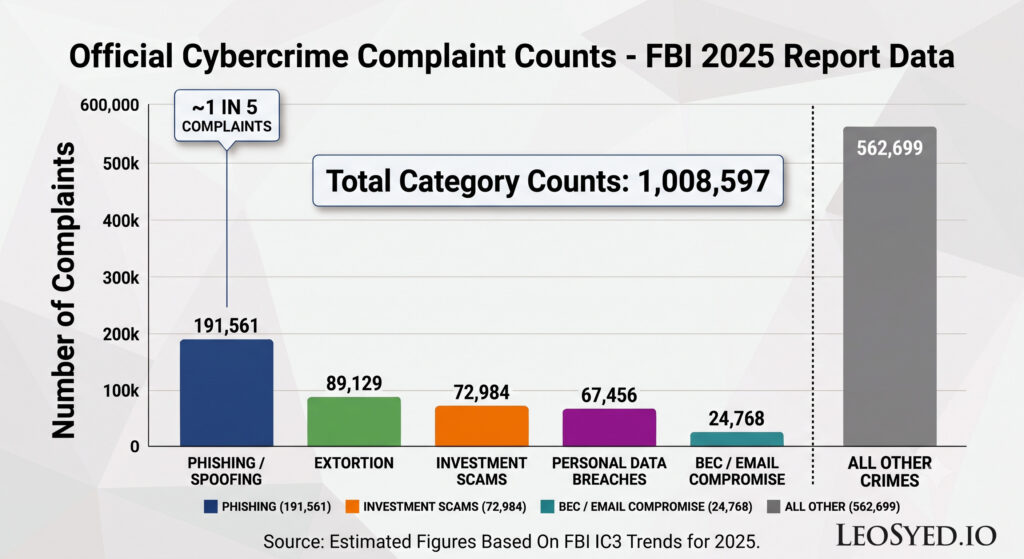
Source: FBI Internet Crime Complaint Center (IC3) 2025 Annual Report.
The Psychology Behind the Phishing Attack: Social Engineering
To protect your organization, you need to understand the psychology that cybercriminals use in phishing attacks.
Phishing is a lot like traditional lake fishing. An angler throws out bait—like a worm—to catch a fish. In cybercrime, a hacker throws out fake digital messages to catch your credentials, financial data, or network access keys.
However, phishing is simply the delivery mechanism. The core strategy behind it is Social Engineering.
Social Engineering is the art of manipulating human psychology to trick people into taking an unsafe action or breaking standard security protocols.
Cybercriminals rarely waste months trying to crack complex encryption when they can persuade a human to hand over a password in 30 seconds. Every phishing attack leverages one of six psychological triggers:
- Urgency: “Your account will be suspended in 2 hours!”
- Authority: “This is the CEO—I need this wire transfer handled now.”
- Fear: “IRS Notice: Legal action pending against your corporation.”
- Curiosity: “See the updated 2026 Q3 employee compensation review list.”
- Greed or Reward: “Claim your $200 corporate performance bonus here.”
- Helpfulness: “This is IT Support. Can you verify your login details so we can clear your inbox space?”
Phishing Attack Process
While cybercriminals use various tactics, almost every phishing attempt boils down to three core steps:
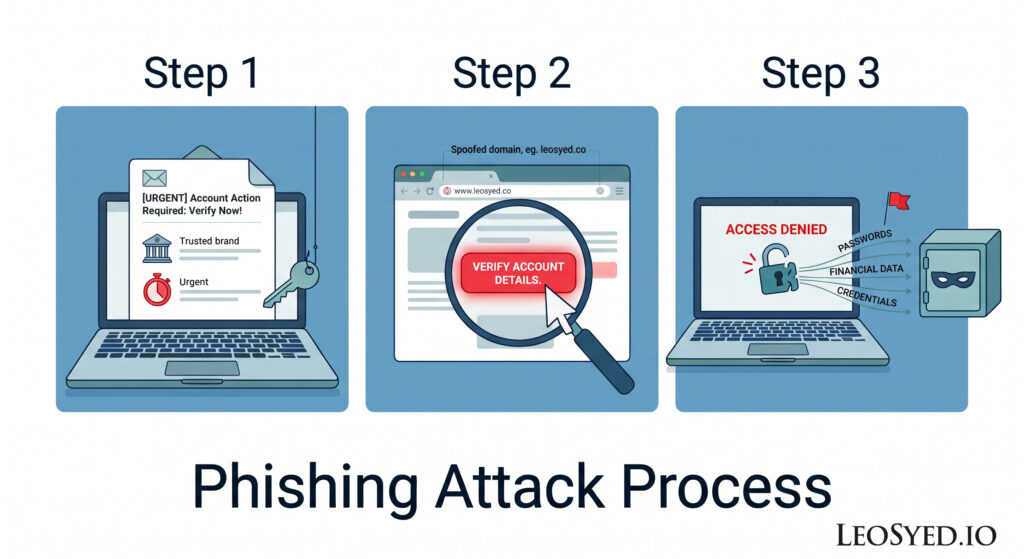
- Step 1: The Lure (Setting the Bait): The attacker crafts a deceptive email, text, or voice message designed to look completely legitimate. By impersonating a trusted vendor, executive, or brand (like Microsoft or your bank), they use psychological triggers like urgency or fear to grab your attention.
- Step 2: The Hook (Prompting Action): The lure includes a specific call to action—a link to a fake login portal, an urgent request to verify account details, or an invoice attachment. The goal is simple: trick the employee into taking an immediate, unverified action before they have time to think.
- Step 3: The Payload (The Extraction): Once the victim bites, the attacker claims the prize. They harvest stolen passwords to hijack accounts, divert wire transfers to a fraud account, or deploy malicious code onto the network.
Key Takeaway for Businesses: An attack only succeeds if all three steps complete sequentially. By combining technical email filters (to block The Lure) with security awareness training (to prevent taking The Hook), you break the chain and keep your company safe.
7 Types of Cyber Phishing Attacks Targeting Your Business
Social engineering has evolved far beyond obvious email scams. If you want your company to survive, you must recognize the seven primary variations thrown at your team every single day:
1. Mass Email Phishing
This is the standard volume-based attack. Cybercriminals send automated messages to millions of addresses pretending to be trusted brands like Microsoft, Google, or major banks. Generative AI tools now allow hackers to draft grammatically flawless emails at scale, removing the obvious red flags like bad spelling that people used to rely on.
2. Spear Phishing (Targeted Attack)
Mass phishing is generic; spear phishing is personal. Attackers conduct Open Source Intelligence (OSINT) research on LinkedIn and corporate websites to learn your job title, key projects, and vendor relationships. The email comes disguised as a specific message from a colleague or client, making it exceptionally hard to spot.
3. Whaling (Executive Phishing)
What happens when a hacker targets the biggest fish in the pond? That is Whaling. These operations specifically target C-suite executives (CEOs, CFOs, Board Members). Attackers impersonate legal authorities, auditors, or key partners demanding urgent financial action or sensitive corporate disclosures.
4. Clone Phishing
This is one of the stealthiest email tactics. An attacker uncovers a real, legitimate email you previously received containing a link or attachment. They duplicate the exact layout, swap out the safe file or link with a malicious payload, and re-send it from a lookalike domain (e.g., 1eoSyed.io instead of leoSyed.io).
5. Smishing (SMS Phishing)
Phishing isn’t restricted to your inbox. Smishing delivers deceptive text messages claiming a bank account is frozen, an invoice is past due, or a package delivery requires link verification. People are three times more likely to click a link sent via text than one sent via email because mobile screens hide full URL structures.
6. Vishing (Voice Phishing & AI Voice Cloning)
Vishing takes social engineering to the telephone. Attackers call employees posing as internal IT helpdesks, Microsoft support, or bank fraud departments. Today, attackers increasingly utilize AI voice-cloning technology—using just a few seconds of public audio from a podcast or webinar—to convincingly impersonate corporate leaders over the phone.
7. Business Email Compromise (BEC)
BEC is where social engineering turns extraordinarily lucrative. Instead of locking down a compromised account right away, an attacker quietly sits inside a hijacked inbox, studying vendor relationships and payment schedules. When a real invoice arrives, the attacker replies using the employee’s actual email address: “We updated our banking details—please wire future funds to this new account instead.”
How to Protect Your Business: A Dual-Layer Defense
Building a resilient business requires a balanced strategy: strengthening your technical guardrails while training human intuition.
The Technical Layer (System Defense)
- Email Authentication Standards: Enforce strict SPF, DKIM, and DMARC records to prevent external attackers from spoofing your domain name.
- Modern Multi-Factor Authentication (MFA): Transition away from vulnerable SMS-based 2FA toward FIDO2 / Hardware Security Keys (e.g., YubiKeys) that are inherently resistant to real-time proxy phishing attacks.
- AI Inbox Protection: Deploy automated email filters that analyze behavioral patterns and domain age rather than relying solely on static blacklists.
The Human Layer (Mindset & Protocols)
Teach your team these three commonsense operational rules:
- Inspect the Sender Domain: Don’t just read the display name. Hover over or tap the sender address to inspect the actual domain extension.
- Hover Before Clicking: Always hover over embedded links to verify the destination URL matches the official website.
- Out-of-Band Verification for Money & Data: Never execute wire transfers, credential resets, or banking detail updates based solely on a digital request. Always verify through a secondary channel—such as calling a trusted internal phone number.
Conclusion
Phishing is no longer just an IT problem—it is an engine powered by human psychology. If your employees do not understand how social engineering works across these seven distinct phishing styles, your corporate network remains exposed.
Is your business protected against modern social engineering techniques?
I help organizations build cyber resilience and train teams to defend against high-level cyber threats. Schedule a consultation and safeguard your corporate data today.